
Bel bonjou tout moun! Nou kontan wè zot ankò! Welcome to a new season of Kwazman Vwa conversations! After a yearlong pause to focus on projects, ourselves, and spend more time with loved ones, we are delighted to be back in community with you all. Much has happened since we last gathered: Jennifer Boum Make’s monograph Decolonial Care: Reimagining Caregiving in the Caribbean came out, as well as Corine Labridy’s translation of Nadia Chonville’s Mon cœur bat vite, as My Heart Beats Fast, and you can already pre-order Nathan Dize’s book, Attending to the Dead: Haitian Literature and the Practice of Mourning, out in March 2027. We celebrated our first Kwazman Vwa wedding, and we may or may not have had a dance party at the Where Oceans Joins conference in Trinidad…
We couldn’t think of a better way to start the season anew than with kindred spirit Agnès Cornélie, founder of La Librairie Calypso, a space dedicated to Caribbean and transoceanic literatures. Over the years, we’ve been grateful to visit Agnès’s bookstore for inspiration and to hear about new publications and authors. Join us to hear about la rentrée littéraire at Calypso, our recent coups de cœur, and what’s on the horizon for Francophone Caribbean literatures. Conversation will be in French. Come prepared to share what you’ve been reading! Register with the form below to receive a link to the Zoom meeting.
October 1, 2026, at 2 p.m. EDT | 11 a.m. MST/PDT | 20 h UTC
Greetings! Bonjou ak bonswa tout moun! We are delighted to close our spring season with another coup de cœur of Caribbean speculative fiction. This time, we’ll be hosting the Grenadian writer, poet, and novelist Merle Collins to discuss her novel The Colour of Forgetting, which was translated into French as La Couleur de l’oubli by our friends Jean-Baptiste Naudy and Grégory Pierrot of Éditions Ròt•Bò•Krik in 2023. The novel is set in the fictional island of Paz where the past, present, and future are animated by storytelling, laughter, and all the sights and sounds soti anwo rive anba. History stalks the inhabitants of Paz from the time of the Ameridians to the present, passed down through prophecies, incantations, and bawdy tales. Collins’s innovative novel is brought alive by a rich diversity of languages and registers that are spectacularly mirrored and transmitted in the French translation. We invite you to join us for our conversation with Merle Collins and we encourage you to read The Colour of Forgetting/La Couleur de l’oubli with us in whichever language moves you most.
Merle Collins is a writer of fiction, poetry and critical essays. Her novels are Ocean Stirrings: A tribute to Louise Langdon Norton Little, Mother of Malcolm X and Seven Siblings (2023), The Colour of Forgetting (2023, 1995), La Couleur de l’oubli (French edition, 2023), Angel (2011, 1997); short story collections: Rain Darling (1997), The Ladies are Upstairs (2011); poetry collections: Lady in a Boat (2003), Rotten Pomerack (1992), Because the Dawn Breaks (1987); a biography, The Governor’s Story: The Authorised Biography of Dame Hilda Bynoe (2013). Her critical works include “Themes and Trends in Caribbean Writing Today” in From My Guy to Sci-Fi: Genre and Women’s Writing in the Postmodern World; “To be Free is Very Sweet,” in Slavery and Abolition; “Cultural Expression and the Grenada Revolution,” a chapter in Nicole Phillips-Dowe & John Angus Martin, ed., Perspectives on the Grenada Revolution; and “Explorations of the Self,” a chapter in Raphael Dalleo and Curdella Forbes, Caribbean Literature in Transition. Collins is also producer of a documentary, Saracca and Nation, exploring African influences on the culture of Grenada and its sister isle, Carriacou. She is Professor Emerita, University of Maryland, College Park.
April 16, 2025, at 10 a.m. EDT | 9 a.m. CDT | 7 a.m. MST/PDT
Bonne année tout le monde! Happy 2025! We cannot think of a better way to start the year than by looking ahead with one of the most compelling young authors of the French Antilles. Michael Roch has been quite busy, collaboratively theorizing a new Caribbean Afrofuturism, Afrofuturisme 3.0, along with Nadia Chonville (Mon coeur bat vite, 2023) and Laura Nsafou (Nos jours brûlés, 2022), and writing novels and short stories in the genre. The Kwazman Vwa team has been buzzing about his latest collection of short stories, Lanvil emmêlée, just recently published with La Volte. With this set of works, Roch adds to the seemingly ever-expanding universe of his watershed novel Tè Mawon, which introduced us to Lanvil, a megalopolis spanning the entire Caribbean arc, including southern Florida. Roch’s work invites us to think and re-think our relationship with technology, the non-human, and each other, as we look ahead to a future increasingly marked by natural catastrophes but also always and forever en voie de créolisation. This conversation will be in French! Register by filling out the form below. We can’t wait to see you!
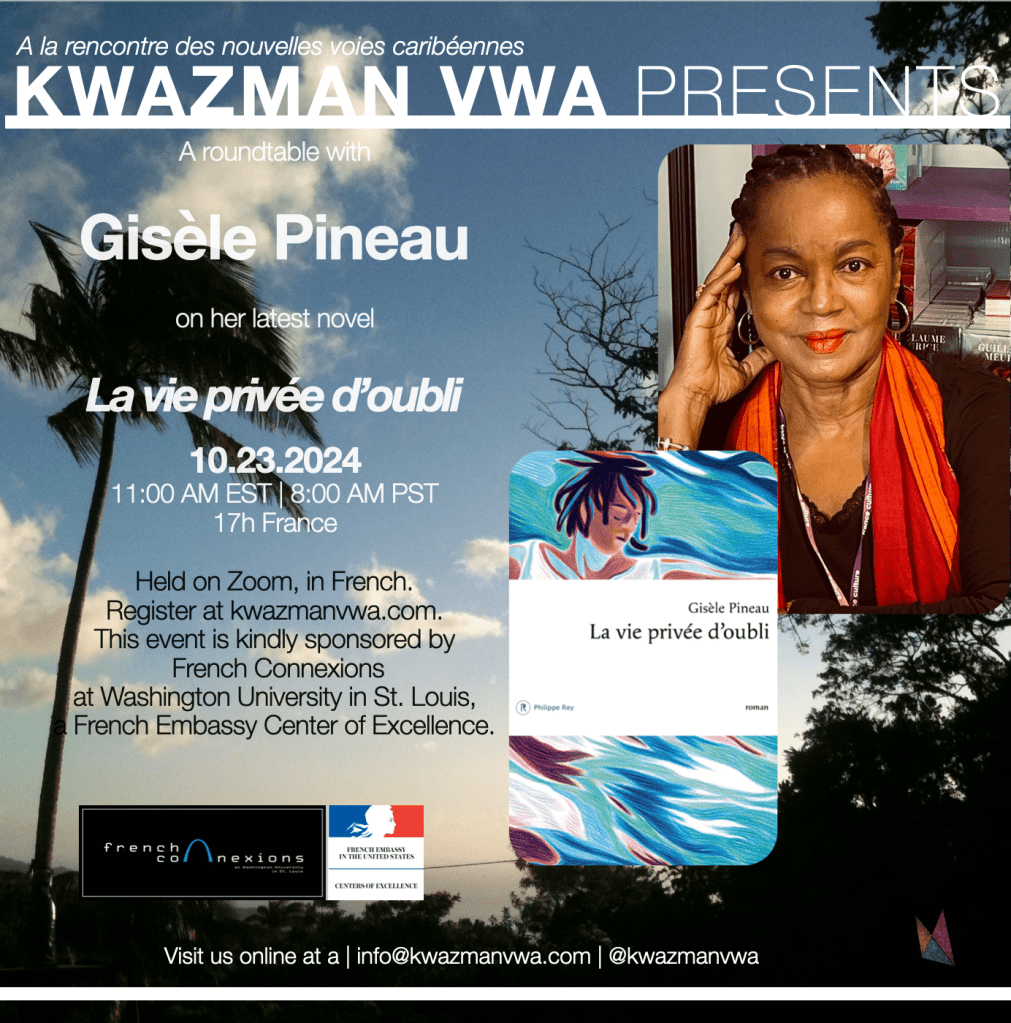
In case we hadn’t made it abundantly clear, we like and love the texts and authors with whom we’ve been in conversation over the years. We believe that what they have to say not only offers insight into Caribbean aliveness but also exceeds regional bounds, venturing into all realms of existence. We’ve been admiring Guadeloupean author Gisèle Pineau’s work for years precisely for these reasons, and this conversation is another dream come true for the Kwazman Vwa collective. Our discussion will focus on Pineau’s latest novel, La vie privée d’oubli (Philippe Rey 2024), which weaves the transatlantic trajectories of women from Guadeloupe, Nigeria, and France to explore generational trauma and the conditions of possibility for individual and collective healing. This conversation will be held in French via zoom, and you can join us by registering below.
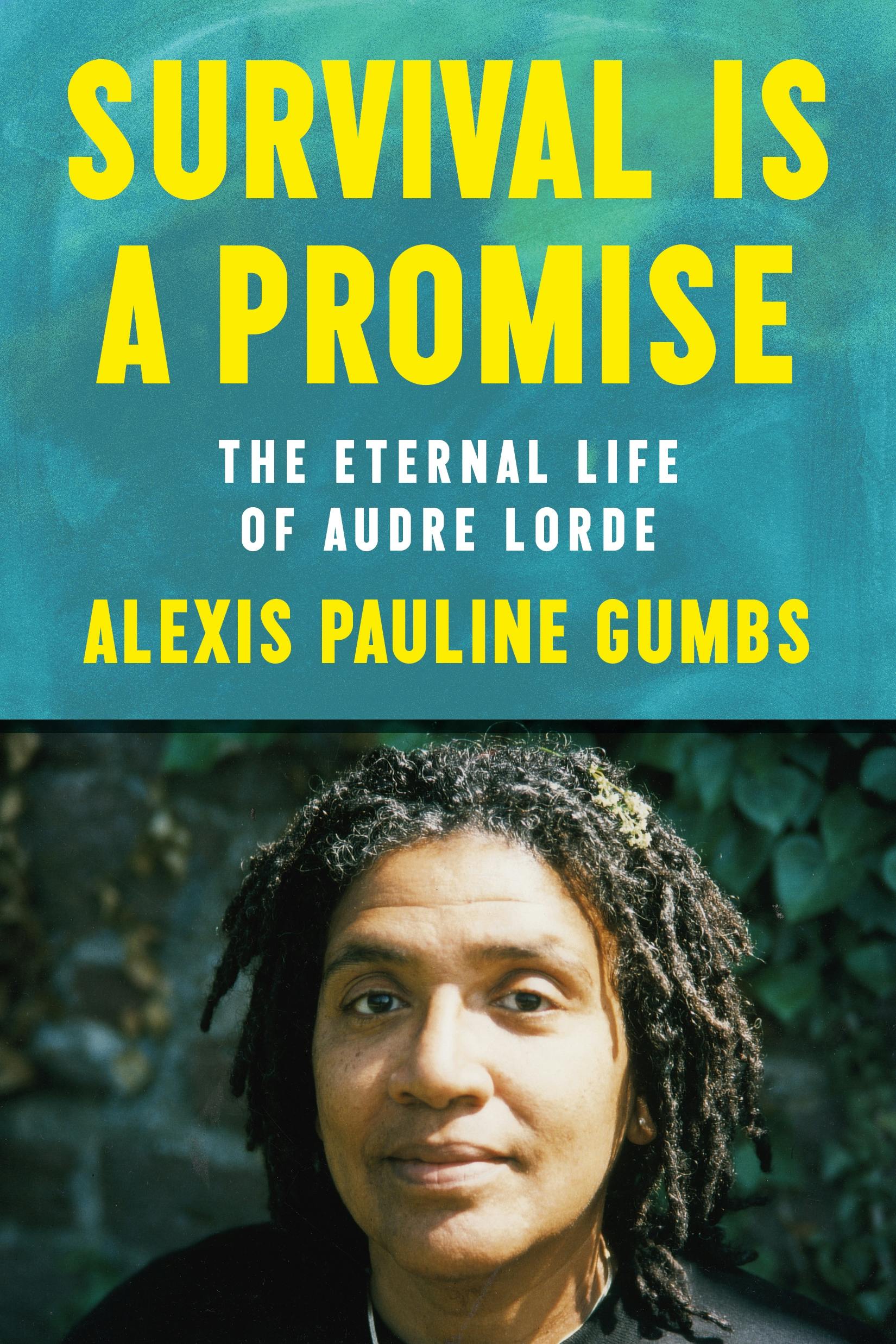
Bienveni, bel bonjou, welcome tout moun! We hope you have all enjoyed a sweet summer! We at Kwazman Vwa certainly have, but we are also very much looking forward to being back in community with each other and with you all. Our first guest this season is scholar, poet, author, teacher, activist, Black feminist love evangelist, Alexis Pauline Gumbs. When our collective first got together a few years ago, in the midst of the pandemic, we made a list of dream guests we would love to be in conversation with, and Alexis Pauline Gumbs was on the earliest of lists. It means so much to us to be starting this season off with her. Her work is essential to making Caribbean lives visible in all their opacity and in effacing the arbitrary borders between disciplines — borders that often maintain Caribbean studies apart from Black feminist thought, poetics and nearly everything else. We will be discussing her latest work, Survival Is a Promise: The Eternal Life of Audre Lorde, which just came out with Farrar, Straus and Giroux. An audio version of the book is already available, read by Gumbs herself, and it is a treasure. This event is generously sponsored by the Francophone, Italian, & Germanic Studies Department at the University of Pennsylvania. Please join us for this conversation via zoom by registering using the form below.
Kwazman Vwa is looking forward to being in conversation with Chris T. Bonner, who is Assistant Professor at Texas A&M University, and who very recently published Cold War Negritude, Form and Alignment in French Caribbean Literature, with Liverpool University Press. His monograph is the first book-length study of francophone Caribbean literature as it unfolded during the global Cold War. It traces the trajectories of three canonical, politically engaged figures of French Caribbean letters, René Depestre, Aimé Césaire, and Jacques-Stephen Alexis, as they wrote and imagined Caribbean modernity against the bipolar backdrop of a divided world order. This conversation will be held in English. Please, use the form below to register.
Kwazman Vwa is proud and (frankly) elated to present the first roundtable for one of its members, our very own Lucy Swanson. Lucy is assistant professor of French Studies at the University of Arizona, a co-founder of Kwazman Vwa, and most importantly here, the author of The Zombie in Contemporary French Caribbean Fiction, published in 2023 with Liverpool University Press. Lucy’s is the first book-length study of the figure of the zombie in Caribbean literatures of French expression. Her insightful readings reveal striking distinctions between the Haitian zombie and its Martinican and Guadeloupean counterparts, and to make sense of it all, she coins four ‘avatars’ of the literary figure: the slave, the trauma victim, the horde, and the popular zombie. The event will be held in English, via Zoom. Register below for the link.
The Kwazman Vwa collective has been buzzing about Grace Sanders Johnson’s recent monograph, White Gloves, Black Nation: Women, Citizenship, and Political Wayfaring in Haiti (published with University of Carolina Press in 2023) — and we’re not the only ones: the book has already garnered the 2023 Haitian Studies Association Book Prize. Following the transatlantic trajectories of elite and middle-class Haitian women during and after the American occupation (1915-1934), Sanders Johnson illuminates what modern Haitian identity owes to these women’s radical activism. The event will be held in English, via Zoom. Register below for the link.
Bònn ane, bonne année, happy new year! We are delighted to kick things off with a roundtable with Tegan Zimmerman on her monograph, Matria Redux. Noting that psychoanalysis tends to ignore racial politics and that postcolonial studies do not systematically account for gender, Zimmerman brings these analytics in conversation and creates a new conceptual apparatus that enables radically fresh readings of mother-daughter relationships in recent Caribbean literatures. The event will be held in English, via Zoom. Register below for the link.
Kwazman Vwa is switching it up this spring, with a focus on recent scholarly works produced about the Caribbean. It’s all about womxn, mothers, daughters, citizens and zombies. Conversations will be held via zoom, in English, all at 1p.m. Registration links to come. Mark your calendars! We look forward to spending time with you in 2024. Be well!
In Matria Redux: Caribbean Women Novelize the Past, author Tegan Zimmerman contends that there is a need for reading Caribbean women’s texts relationally. This comprehensive study argues that the writer’s turn to maternal histories constitutes the definitive feature of this transcultural and transnational genre. Through an array of Caribbean women’s historical novels published roughly between 1980 and 2010, this book formulates the theory of matria—an imagined maternal space and time—as a postcolonial-psychoanalytic feminist framework for reading fictions of maternal history written by and about Caribbean women.
White Gloves, Black Nation by Grace Sanders Johnson
Winner of the 2023 Haitian Studies Association Book Prize
This ambitious transnational history considers Haitian women’s political life during and after the United States occupation of Haiti (1915–34). The two decades following the occupation were some of the most politically dynamic and promising times in Haiti’s modern history, but the history of women’s political organizing in this period has received scant attention. Tracing elite and middle-class women’s activism and intellectual practice from the countryside of Kenscoff, Haiti, to Philadelphia, the Belgian Congo, and back to Port-au-Prince, this book tells the story of Haitian women’s essential role as co-curators of modern Haitian citizenship.
The Zombie in Contemporary French Caribbean Fiction by Lucy Swanson
We’ve been particularly excited to chat with Kwazman Vwa’s very own Lucy Swanson about her monograph on the rise and trajectory of the figure of the Zombie, as it emerged out of the Caribbean.
Believed to have emerged in the French Caribbean based on African spirit beliefs, the zombie represents not merely the walking dead, but also a walking embodiment of the region’s history and culture. In Haiti today, the zombie serves as an enduring memory of enslavement: it is defined as a reanimated body robbed of part of its soul, forced to work in sugarcane fields. In Martinique and Guadeloupe, the zombie takes the form of a shape-shifting evil spirit, and represents the dangers posed to the maroon or “freedom runner.” The Zombie in Contemporary French Caribbean Fiction is the first book-length study of the literary zombie in recent fiction from the region. It examines how this symbol of the enslaved (and of the evil spirits that threaten them) is used to represent and critique new socio-political situations in the Caribbean. It also offers a comprehensive and focused examination of the ways contemporary authors from Haiti and the French Antilles contribute to the global zombie imaginary, identifying four “avatars” of the zombie—the slave, the trauma victim, the horde, and the popular zombie—that appear frequently in fiction and anthropology, exploring how works by celebrated and popular authors reimagine these archetypes.