
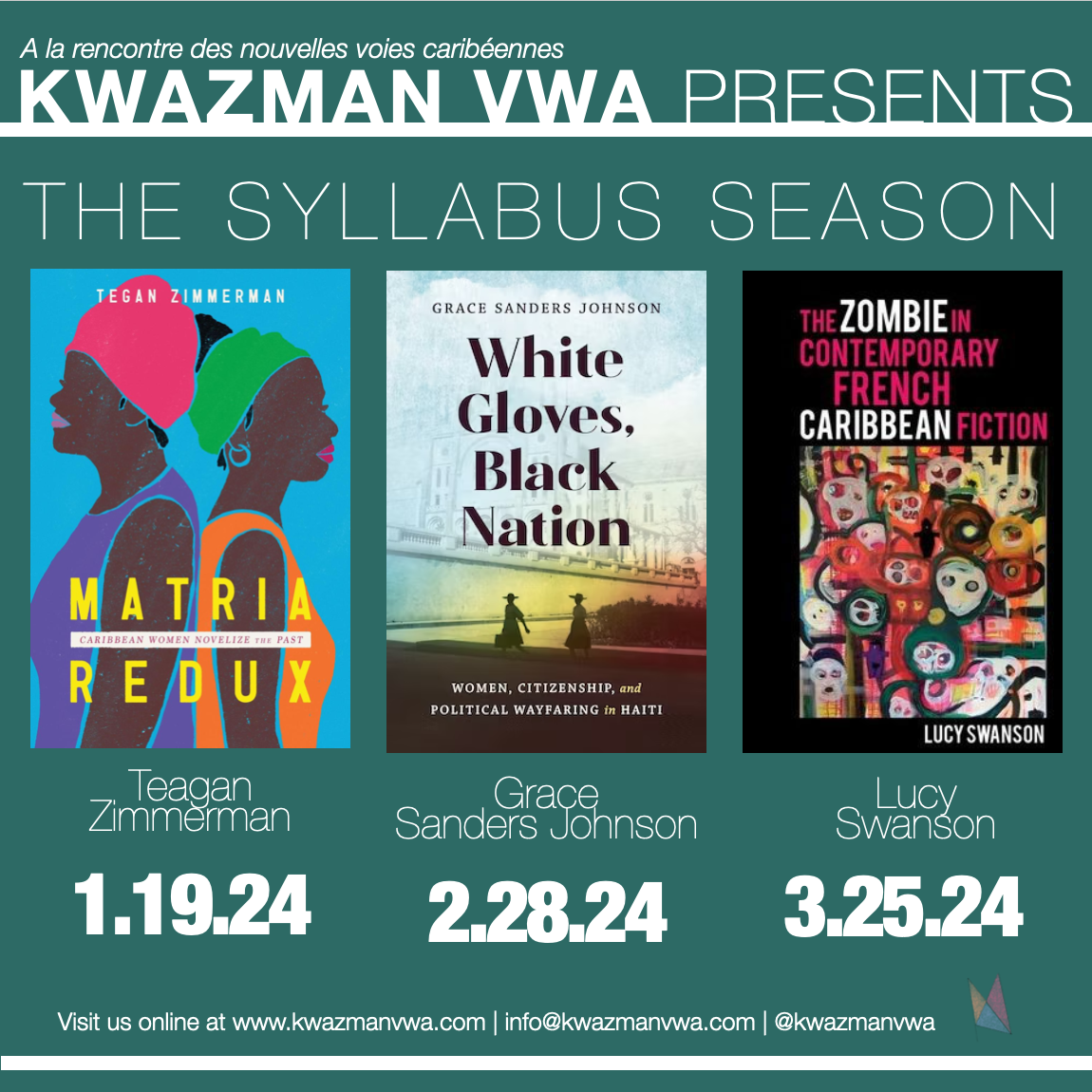
Kwazman Vwa is switching it up this spring, with a focus on recent scholarly works produced about the Caribbean. It’s all about womxn, mothers, daughters, citizens and zombies. Conversations will be held via zoom, in English, all at 1p.m. Registration links to come. Mark your calendars! We look forward to spending time with you in 2024. Be well!
Matria Redux by Teagan Zimmerman
Description from Mississippi Press:
In Matria Redux: Caribbean Women Novelize the Past, author Tegan Zimmerman contends that there is a need for reading Caribbean women’s texts relationally. This comprehensive study argues that the writer’s turn to maternal histories constitutes the definitive feature of this transcultural and transnational genre. Through an array of Caribbean women’s historical novels published roughly between 1980 and 2010, this book formulates the theory of matria—an imagined maternal space and time—as a postcolonial-psychoanalytic feminist framework for reading fictions of maternal history written by and about Caribbean women.
White Gloves, Black Nation by Grace Sanders Johnson
Description from the University of North Carolina Press:
Winner of the 2023 Haitian Studies Association Book Prize
This ambitious transnational history considers Haitian women’s political life during and after the United States occupation of Haiti (1915–34). The two decades following the occupation were some of the most politically dynamic and promising times in Haiti’s modern history, but the history of women’s political organizing in this period has received scant attention. Tracing elite and middle-class women’s activism and intellectual practice from the countryside of Kenscoff, Haiti, to Philadelphia, the Belgian Congo, and back to Port-au-Prince, this book tells the story of Haitian women’s essential role as co-curators of modern Haitian citizenship.
The Zombie in Contemporary French Caribbean Fiction by Lucy Swanson
We’ve been particularly excited to chat with Kwazman Vwa’s very own Lucy Swanson about her monograph on the rise and trajectory of the figure of the Zombie, as it emerged out of the Caribbean.
Description from Liverpool University Press:
Believed to have emerged in the French Caribbean based on African spirit beliefs, the zombie represents not merely the walking dead, but also a walking embodiment of the region’s history and culture. In Haiti today, the zombie serves as an enduring memory of enslavement: it is defined as a reanimated body robbed of part of its soul, forced to work in sugarcane fields. In Martinique and Guadeloupe, the zombie takes the form of a shape-shifting evil spirit, and represents the dangers posed to the maroon or “freedom runner.” The Zombie in Contemporary French Caribbean Fiction is the first book-length study of the literary zombie in recent fiction from the region. It examines how this symbol of the enslaved (and of the evil spirits that threaten them) is used to represent and critique new socio-political situations in the Caribbean. It also offers a comprehensive and focused examination of the ways contemporary authors from Haiti and the French Antilles contribute to the global zombie imaginary, identifying four “avatars” of the zombie—the slave, the trauma victim, the horde, and the popular zombie—that appear frequently in fiction and anthropology, exploring how works by celebrated and popular authors reimagine these archetypes.
 kwazman vwa